
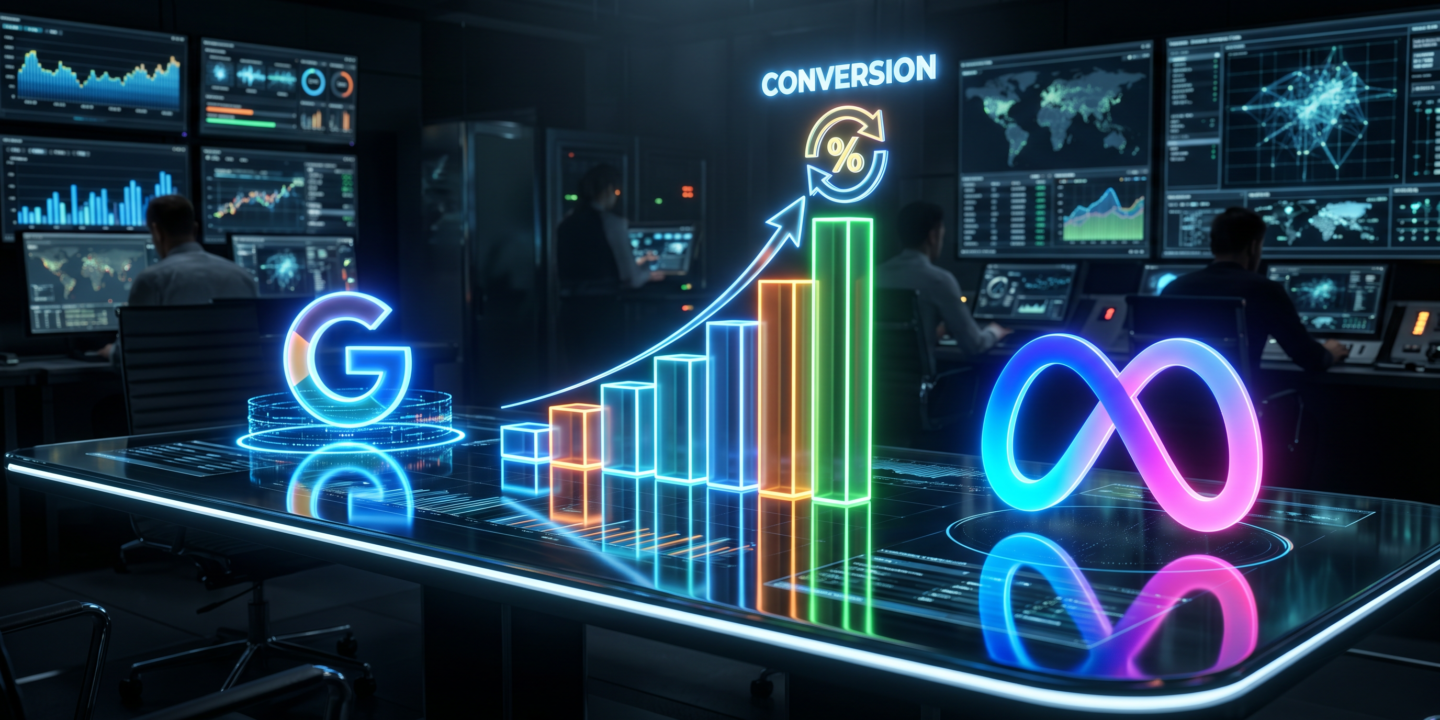
The duopoly of Meta and Google still commands over 50% of global digital ad spend, but the “how-to” of 2024 is now obsolete. In 2026, high-converting campaigns are no longer built on granular manual targeting—they are built on Creative Excellence and Signal Health.
If you want to stop “spending” and start “investing,” you need to master the different psychological states of the user on each platform. Here is your roadmap to dominance.
1. Google Ads: Mastering the “Intent” Engine
Google is where people go to find solutions. In 2026, the focus has shifted entirely to Performance Max (PMax) and Search Generative Experience (SGE) optimization.
- Broad Match + Smart Bidding: Gone are the days of hyper-specific phrase matching. Today, Google’s AI is better at predicting intent than we are. Use Broad Match combined with a robust list of “Negative Keywords” to give the AI the guardrails it needs.
- The “Authority” Asset: Ensure your “Site Links” and “Lead Forms” are fully optimized. In 2026, users often convert directly on the Google Search Results Page (SERP) without ever visiting your website.
- GEO-Optimization: Use Location Extensions to dominate local search intent. For instance, “Best Video Production in [City]” should trigger a map-based ad that builds immediate regional trust.
2. Meta Ads: Mastering the “Interruption” Engine
Meta (Facebook & Instagram) is where people go to be inspired. You aren’t answering a question; you are interrupting a scroll.
- The “Creative-First” Strategy: In 2026, the creative is the targeting. The algorithm analyzes your video’s transcript and visual elements to decide who to show it to. If your video features “Motion Graphics for SaaS,” Meta will find SaaS founders for you.
- Advantage+ Everything: Use Meta’s Advantage+ Shopping and Creative suites. The more autonomy you give the algorithm, the lower your CPA (Cost Per Acquisition) tends to be.
- Short-Form Video (Reels): 80% of Meta’s growth is driven by Reels. High-converting campaigns must lead with 9:16 vertical video that feels “Native” rather than “Corporate.”
3. The 2026 Comparison: Which Platform When?
| Feature | Google Ads | Meta Ads |
| User Mindset | Active Search (High Intent). | Passive Discovery (High Emotion). |
| Primary Format | Text, Shopping, & YouTube. | Video, Image, & Carousel. |
| Best For | Direct Sales & Immediate Solutions. | Brand Awareness & Impulse Buys. |
| Key Metric | Search Volume & Impression Share. | Hook Rate & Hold Rate. |
4. The “Signal” Revolution: Data in a Cookieless World
To run high-converting campaigns in 2026, your “tracking” must be bulletproof.
- CAPI (Conversions API): Browser-based tracking is dead. You must implement Meta’s Conversions API and Google’s Enhanced Conversions to send server-side data directly to the platforms.
- First-Party Data: Use your email lists to create “Value-Based Lookalike Audiences.” This tells the AI to find people who look like your highest-paying customers, not just your most frequent visitors.
- LTV Modeling: Optimize your campaigns for Lifetime Value, not just the first click.
5. SEO & Growth Advice: Positioning for Authority
- Dwell Time is King: Don’t just send traffic to a homepage. Send them to a high-authority blog post or an interactive tool. This increases the “Quality Score” of your ads, lowering your costs.
- Actionable Advice: Audit your “Hook Rate” (the % of people who watch the first 3 seconds of your Meta ad). If it’s below 30%, your creative is failing, regardless of your targeting.










No Comments